Analyze timesheets and shifts.
- Formats accepted
- 14
- Stages
- 3
- Analysis behind it
- the full one
No account needed to start. You only pay when you like what you see.
- .xlsx. Excel workbook. Every sheet read, including the ones that are notes rather than data.
- .xls. Excel 97–2003. Read the same as a modern workbook.
- .xlsm. Excel, macro-enabled. Values and formulas are read. Macros are never executed.
- .ods. OpenDocument spreadsheet. LibreOffice and OpenOffice workbooks, read like Excel.
- .numbers. Apple Numbers. Tables are pulled out of the Numbers package sheet by sheet.
- .csv. CSV. Delimiter, quoting and encoding detected rather than assumed.
- .tsv. Tab-separated. Read as delimited text.
- .pdf. PDF. Checked for a text layer first. A PDF written by software keeps its table structure; a scan is read as an image and told apart from the first kind.
- .docx. Word document. Tables are lifted out of the document; the prose around them is kept as context.
- .pptx. PowerPoint deck. Tables and the data behind native charts are read slide by slide.
- .rtf. Rich text. Tables extracted, formatting discarded.
- .txt. Plain text. Read as notes, or as data when the contents turn out to be a table.
- .md. Markdown. Markdown tables become tables; the rest becomes context for the analysis.
- .zip. Zip archive. Unpacked, and each file inside is treated as though you had uploaded it yourself.
What comes back
A finished project, rendered by the components that render your own.
The overtime is not spread across the team, and the people carrying it are the ones leaving.
Eleven people worked 6,884 of the year's 18,412 overtime hours, and nine of them are on the night rota. Seven of those eleven have since left. Separately, the 27% attrition the business reports is computed on closing headcount, which flatters a year in which headcount grew from 198 to 226; on average headcount the same 61 leavers give 28.8%. Seven in ten of them left inside their first year.
Most of the leaving happens in the first year
43 of 61 leavers were inside their first year
- 01Eleven people worked 37% of the overtime, and seven of them have left.
- 02Attrition is 28.8%, not the 27.0% currently reported.
- 03Seven in ten leavers went inside their first year.
It reconciles the rota against the clock
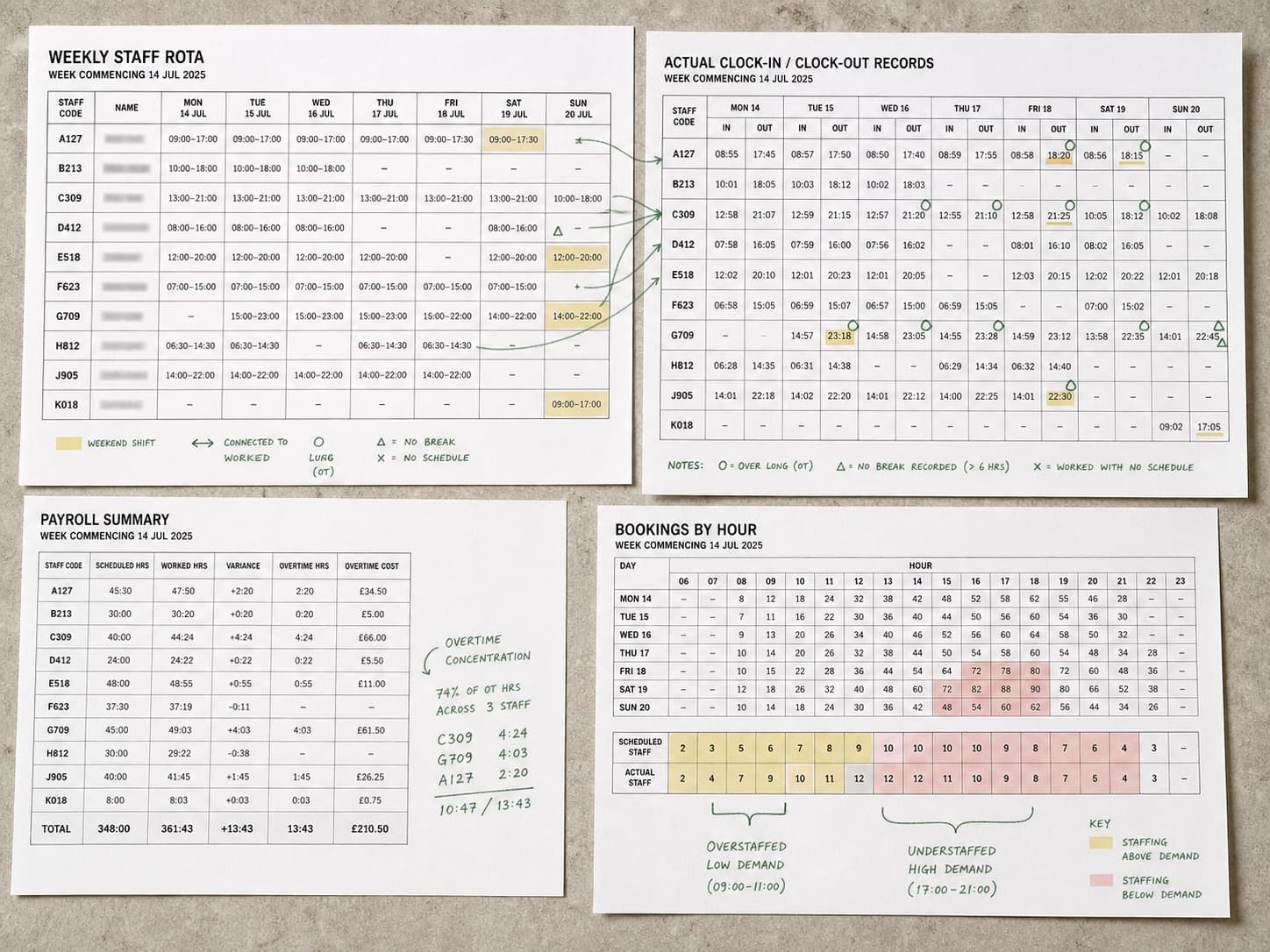
Scheduled hours and worked hours are different files that disagree, and the disagreement is the finding. Shifts that routinely run long, breaks that are scheduled and never taken, and hours worked with no shift behind them are separated rather than summed.
It looks at who, not just how much
Total overtime is a number nobody can act on. Concentration is actionable: overtime that sits with four people is a rota problem, and the same hours spread across forty is a demand problem.
It sets labour against whatever else you have
Given sales, bookings or output for the same period, cost is reported per hour of demand rather than per hour worked, which is where over-staffed quiet shifts become visible.
It expects a mess.
Most files that arrive here have several tables on one sheet, a title block above the data, totals stranded in the middle of it, and dates in more than one format. That is the normal case, not the awkward one.
- Scheduled against worked hours, reconciled
- Overtime by person, shift and week
- Shifts consistently over or under staffed
- Labour cost against demand, where demand data exists
| Order | Date | Customer | Amt |
|---|---|---|---|
| 10241 | 07/02/26 | John Smith | $84.00 |
| 10242 | 2 July 2026 | SARAH LOPEZ | $41.00 |
| 10242 | 2 July 2026 | SARAH LOPEZ | $41.00 |
| 10243 | 45840 | s. lopez | 41 |
| Not supplied | Not supplied | SUBTOTAL | $166.00 |
| 10244 | 2026-07-03 | Amara Osei | $127.50 |
Questions it works through
Run against every dimension, not the three you had time for.
- Who is doing the overtime, and is it the same people every week?
- Which shifts are always short, and which are never busy?
- How much of my labour cost is scheduled, and how much just happens?
- Are breaks being taken?
Questions people ask
Before anybody has uploaded anything.
What if my rota and my timesheets are in different systems?
That is the normal case and the reason this is worth doing. They are matched on person and date, and everything that fails to match is reported as its own finding rather than quietly dropped.
Can it handle a small team?
Yes, and it will refuse to express a four-person pattern as a percentage. Below thirty of anything, counts are reported instead of rates, because one person moves a small rate further than the effect being measured.
Is this payroll software?
No. It calculates nothing you owe anyone and files nothing with anybody. It answers the questions about hours that payroll records but never asks: who is carrying the overtime, which shifts are consistently short, and where the cost is drifting week to week.
Keep going
The neighbouring jobs, and what happens to each file type this takes.
Upload timesheets
No account needed to start. You only pay when you like what you see.