See when you run out of cash.
- Formats accepted
- 18
- Stages
- 3
- Analysis behind it
- the full one
No account needed to start. You only pay when you like what you see.
- .xlsx. Excel workbook. Every sheet read, including the ones that are notes rather than data.
- .xls. Excel 97–2003. Read the same as a modern workbook.
- .xlsm. Excel, macro-enabled. Values and formulas are read. Macros are never executed.
- .ods. OpenDocument spreadsheet. LibreOffice and OpenOffice workbooks, read like Excel.
- .numbers. Apple Numbers. Tables are pulled out of the Numbers package sheet by sheet.
- .csv. CSV. Delimiter, quoting and encoding detected rather than assumed.
- .tsv. Tab-separated. Read as delimited text.
- .pdf. PDF. Checked for a text layer first. A PDF written by software keeps its table structure; a scan is read as an image and told apart from the first kind.
- .docx. Word document. Tables are lifted out of the document; the prose around them is kept as context.
- .pptx. PowerPoint deck. Tables and the data behind native charts are read slide by slide.
- .rtf. Rich text. Tables extracted, formatting discarded.
- .ofx. OFX statement. Transactions come with their own type codes and references, which makes matching far better than a CSV.
- .qfx. Quicken statement. Read as OFX, which is what it is underneath.
- .qbo. QuickBooks statement. Read as OFX, with the QuickBooks account mapping kept.
- .sta. MT940 statement. The SWIFT tags are parsed into transactions, balances and references.
- .txt. Plain text. Read as notes, or as data when the contents turn out to be a table.
- .md. Markdown. Markdown tables become tables; the rest becomes context for the analysis.
- .zip. Zip archive. Unpacked, and each file inside is treated as though you had uploaded it yourself.
What comes back
A finished project, rendered by the components that render your own.
You do not have a slow season. You have two clients who pay in 67 days.
Receipts fell 30% across November to January, which the business has been treating as a seasonal dip and planning around. Work invoiced over the same months fell 3%. The gap is collections: two clients on nominal 30-day terms paid at an average of 67 days, and every one of the 38 days the account spent overdrawn began between 30 and 45 days after an invoice to one of them.
The work did not stop. The money did.
- 01The winter dip is in the collections, not in the work.
- 02Two clients, 38% of revenue, account for every overdrawn day.
- 03$7,344 a year leaves for software that nothing uses.
It measures each client separately
One average payment delay describes nobody. Each client gets their own distribution, because the risk is never spread evenly: in the worked example two clients on 30-day terms pay at 74 and 61 days, and they are 38% of revenue and 100% of the days the account spent overdrawn.
It takes out the money that is not yours
Client deposits for costs not yet spent, and tax collected and not yet paid, sit in the same balance as your own cash and are the reason a healthy-looking account runs out. Separating them takes the example's runway from 11 weeks to 6.4. That difference is larger than the overdraft that prompted the analysis.
It forecasts days, not months
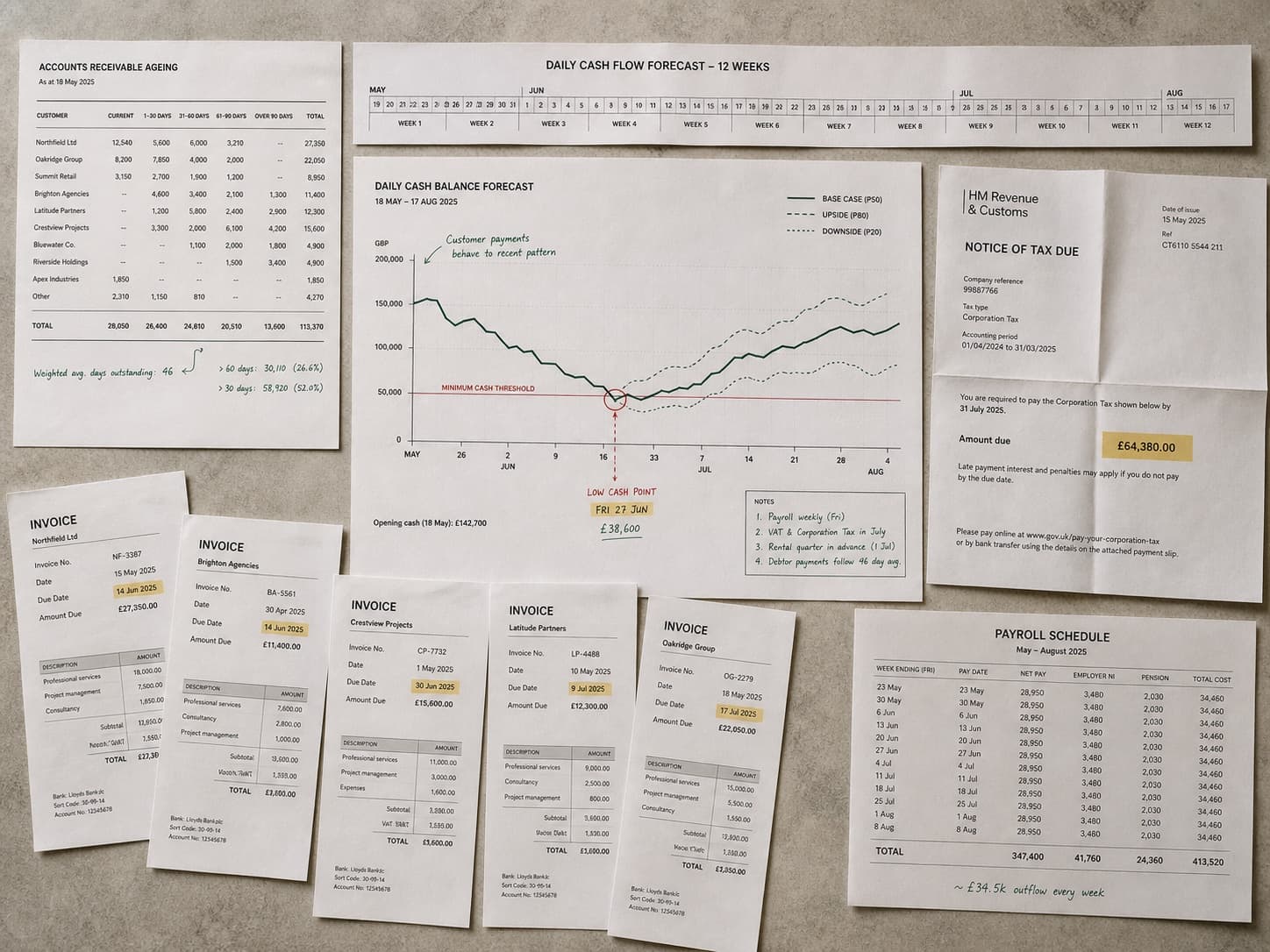
A monthly forecast is a forecast of the one day a month you happen to look. The projection is daily, so it names the dates you go under rather than the month you probably will, and every scenario you try is kept beside the original instead of replacing it.
It expects a mess.
Most files that arrive here have several tables on one sheet, a title block above the data, totals stranded in the middle of it, and dates in more than one format. That is the normal case, not the awkward one.
- Daily projected balance, with the dates you go below zero
- How each client actually pays, against their terms
- Runway with client money and tax separated out
- Scenarios, kept side by side
- Cleaned .xlsx and methodology
| Order | Date | Customer | Amt |
|---|---|---|---|
| 10241 | 07/02/26 | John Smith | $84.00 |
| 10242 | 2 July 2026 | SARAH LOPEZ | $41.00 |
| 10242 | 2 July 2026 | SARAH LOPEZ | $41.00 |
| 10243 | 45840 | s. lopez | 41 |
| Not supplied | Not supplied | SUBTOTAL | $166.00 |
| 10244 | 2026-07-03 | Amara Osei | $127.50 |
Questions it works through
Run against every dimension, not the three you had time for.
- On which day, exactly, do I go under?
- If my two slowest clients paid at 45 days instead, what changes?
- How much of this balance is deposits and tax I am holding?
- Is this a slow season, or a collections problem dressed as one?
Questions people ask
Before anybody has uploaded anything.
How far ahead does it forecast?
Thirteen weeks by default, because that is how far committed invoices and known recurring costs actually reach. It will go further if you ask, and everything beyond the committed horizon is drawn and labelled as assumption rather than blended into the same line.
Can it account for a contract I signed yesterday?
Correct, so tell it. Add expected work, a hire, or a price change in plain language and the forecast rebuilds. Anything you added is listed separately from anything measured, so you can always see which part of the line is evidence and which part is you.
Why not just use the payment terms on my invoices?
Because terms are what you asked for and the forecast needs what happens. The worked example is a business whose invoices all say 30 days and whose money arrives, on average, on day 46, and the entire winter cash crisis lives in that gap.
My income is irregular. Does that break it?
That is the case it is built for. Irregular income is forecast from your own history as a range rather than a single line, and the output is the date you go under under each scenario, not a smooth average that has never happened once.
Keep going
The neighbouring jobs, and what happens to each file type this takes.
Upload statements and invoices
No account needed to start. You only pay when you like what you see.