How do you calculate nonprofit donor retention?
For a consecutive-year measure, divide donors who made a qualifying gift in both years by donors who gave in the first year. Count each donor once per year and keep the donor identity and gift definitions stable. Show reactivated and newly observed donors separately, and distinguish donor retention from the share of gift revenue retained.
Key numbers
- 400
- example prior-year donors
- 240
- donors giving in both years
- 60%
- consecutive-year donor retention
Key takeaways
- Define the donor unit and qualifying gift consistently.
- Count a monthly donor once, not once per payment.
- Keep retained, reactivated, and newly observed donors distinct.
A nonprofit can receive more donations while retaining fewer donors. A small number of larger gifts may cover the lost relationships, or a monthly giving program may create many transactions from the same people. Start with a consistent donor-level definition before interpreting the trend.
This example uses fictional counts and calendar-year periods. It describes one transparent measure: donors who gave in both consecutive years divided by donors who gave in the first year. It does not measure retention of every contact, event attendance, or the share of last year's dollars that returned.
Section 01
Define a donor and a qualifying gift
Choose whether the unit is an individual, household, organization, or another stable entity. Do not switch units between periods. Shared addresses are not enough to infer that two people are the same donor, and a changed email does not necessarily mean a new donor. Keep identity resolution documented and review uncertain matches.
Define qualifying gifts and their dates. Pledges, fulfilled payments, in-kind gifts, refunded transactions, and event purchases may need different treatment. Apply the same rule in both years. Do not count a pledge and its later fulfillment as two independent contributions in a receipt-based report.
Section 02
Build one eligible donor list for each year
Deduplicate qualifying records to one donor per year. If someone makes twelve monthly payments, they appear once in that year's donor count. Keep gift count and total amount as separate measures; each helps describe the relationship, but neither is the denominator of this donor-retention rate.
In a spreadsheet, prepare a helper table with a stable donor ID and one qualifying-gift flag per year. COUNTIFS can count rows meeting both year flags once the helper table really contains one row per donor. Check that its distinct donor total reconciles to the source, with unresolved identity records shown separately.
Section 03
Calculate the rate and the movement together
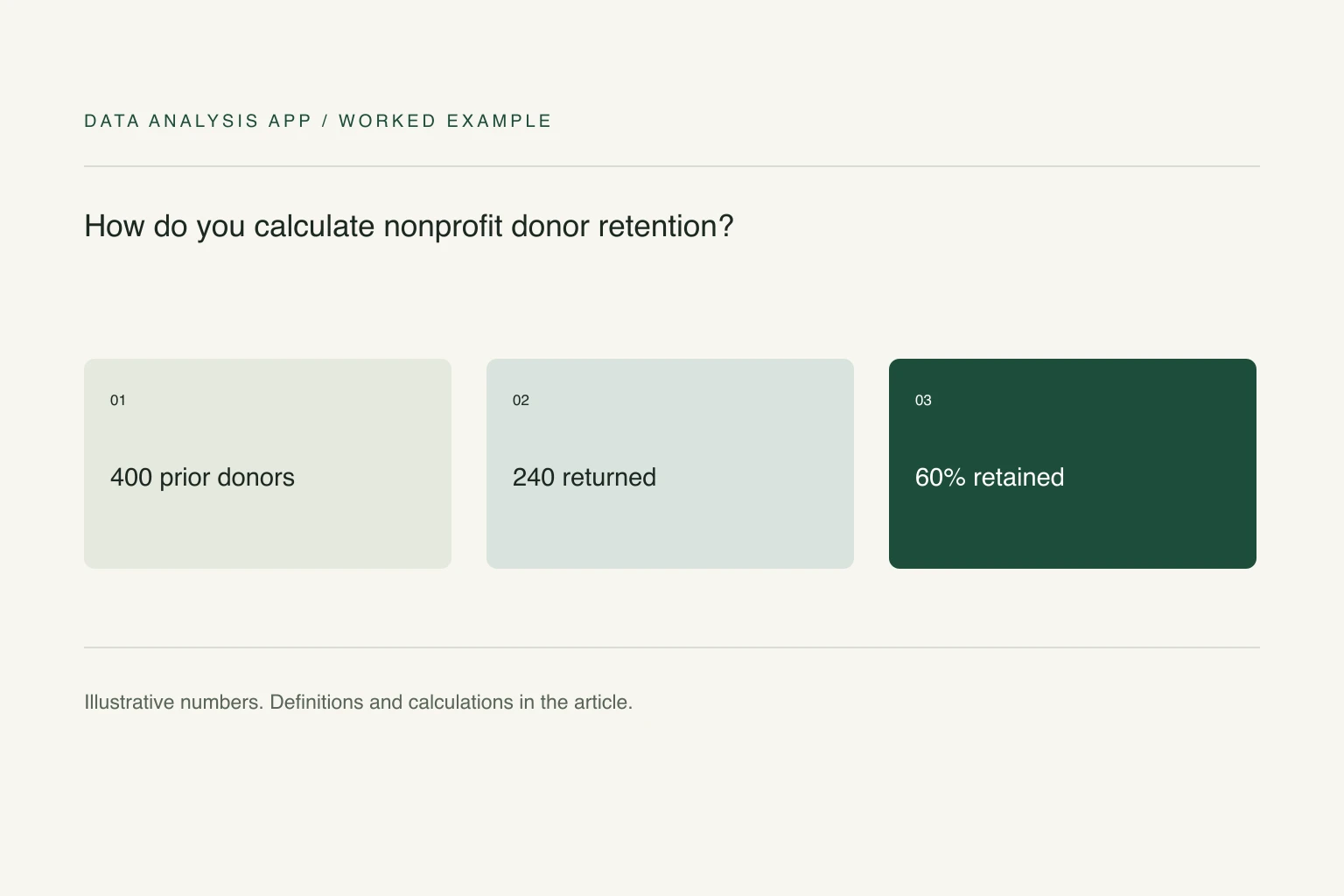
Suppose 400 donors gave last year. Of those, 240 also gave this year. Retention is 240/400 = 60%, and 160 prior donors did not give this year under the chosen definition. If 100 first-time donors and 30 donors returning after a longer gap also gave, this year's total is 370.
The 30 reactivated donors are part of this year's donor total but are not retained from last year. Keep retained, first-time, and reactivated groups distinct. If the export's history does not extend far enough to establish first-ever giving, label the group Newly observed rather than First-time.
Section 04
Separate donor retention from revenue retention
The 240 retained donors may give more, less, or the same amount as before. Compare their total gifts across both years to understand that movement. A 60% donor-retention rate does not imply that 60% of last year's gift revenue returned. Large gifts can make the two measures diverge sharply.
For recurring programs, consider a separate schedule-based measure because a missed monthly payment and a donor who renews once a year have different opportunities to give. A partially observed year should not be compared with a complete prior year without making the coverage clear. Do not label everyone who has not yet given this year as permanently lost.
Section 05
Use the report to ask better questions
Review changes by a small number of relevant segments, such as initial giving period or acquisition channel, while keeping the group sizes visible. Avoid attributing a change to a campaign merely because the dates line up. Suppress or combine small groups when a public report could identify individual donors.
The nonprofit use case shows a broader reporting workflow. You can start an analysis using an export with names and contact details removed. Keep the identity, gift, and period definitions with any chart so the next reporting cycle measures the same relationships.
See it on a real project
5,510 people were stored as 6,214 records, depressing reported retention by 10.9 points.
Keep reading
Evidence
Sources
- Microsoft (2026). COUNTIFS function.
- Data Analysis App team (2026). Related method: customer retention cohort analysis excel.
- Data Analysis App team (2026). Worked project: donor retention.