How do freelancers calculate client profitability?
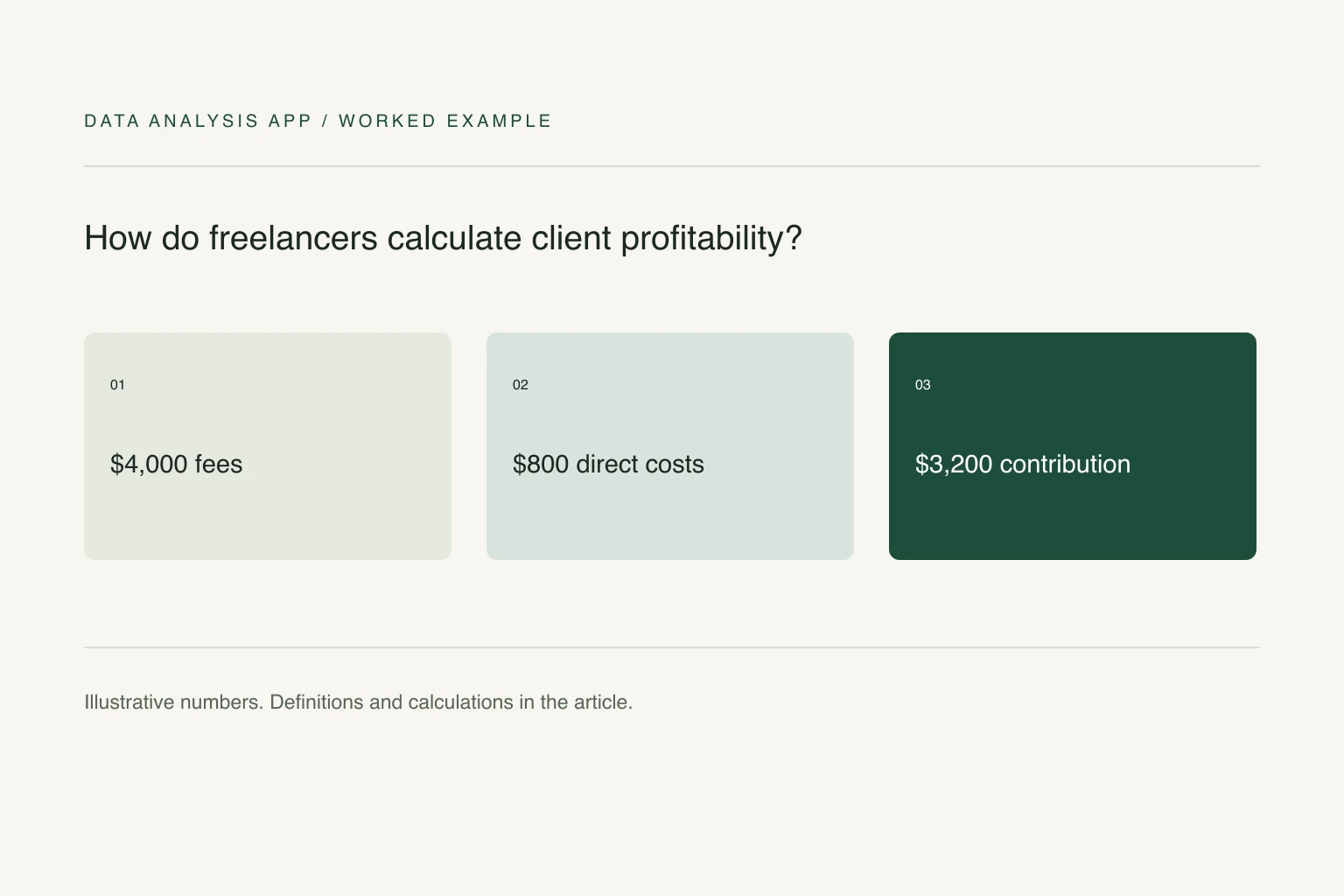
Subtract client-specific costs from fees after credits to calculate contribution before shared overhead. Divide by all hours spent delivering and managing the work, including revisions and administration. Compare clients using the same definitions, show collected cash separately from invoiced fees, and test whether missing time would change the ranking.
Key numbers
- $4,000
- example fees after credits
- $3,200
- contribution before overhead and own labor
- $64/hour
- contribution across all 50 hours
Key takeaways
- Include revisions, coordination, and collection time.
- Contribution before overhead is different from net profit.
- Show total contribution, contribution per hour, and cash collection separately.
The client with the largest invoice is not automatically the client that pays best. Profitability changes when you include revisions, unpaid calls, subcontractors, and the time spent collecting payment. Build a client-level view before raising rates or accepting another project on the same terms.
This walkthrough uses hypothetical numbers and a deliberately simple managerial calculation. It is a way to compare work on consistent terms, not a substitute for financial statements or tax advice. Keep cash collection separate from the value of the work delivered.
Section 01
Bring the right rows together
Export invoices, credit notes, direct expenses, and time entries for the same period. Give every row a stable client identifier. Names alone are fragile: ACME Ltd and Acme Limited may be the same client, while two unrelated companies may share a shortened name. Resolve those differences in a visible mapping table before calculating anything.
Count each invoice once and subtract credit notes once. A payment processor export may contain both an authorization and its settlement; those are not two sales. If invoices have multiple lines, join time and expense summaries at client level rather than repeating an invoice total on every time row. The guide to merging spreadsheets explains why row multiplication can produce plausible but inflated totals.
In Excel, SUMIFS can total fees or costs for a client and period. Aggregate each source separately before comparing the totals; applying a formula to an already multiplied join will only sum the duplicated rows correctly.
Section 02
Measure contribution before allocating overhead
For a hypothetical client, start with $4,000 in invoiced fees after credits. Subtract $600 in subcontractor costs and $200 in project-specific expenses. The remaining $3,200 is contribution before shared overhead and your own labor. Label it that way rather than calling it net profit.
Now count 32 delivery hours, eight revision hours, and ten hours of meetings and administration. Divide $3,200 by all 50 hours to obtain $64 of contribution per hour. Dividing by delivery time alone would show $100 per hour and conceal the cost of managing the relationship. Record estimates separately from logged time so the precision of the result is not overstated.
Section 03
Compare clients using the same treatment of time
Consider a second client with $2,400 in fees, $200 of direct costs, and 20 total hours. Contribution is $2,200, or $110 per hour. This smaller client uses capacity more efficiently in the example, even though it contributes fewer total dollars. Neither metric replaces the other: a business needs both enough total contribution and a sustainable use of available time.
If you want a labor-adjusted estimate, choose an internal hourly cost and apply it consistently. At $40 per hour, the first client's 50 hours consume $2,000, leaving $1,200 before shared overhead. Do not subtract an internal labor cost and then describe the resulting amount per hour as your take-home wage. They answer different questions.
Section 04
Check whether the result survives uncertainty
Unrecorded time can reverse a ranking. Add a sensitivity column for a plausible amount of missing administration and rerun the comparison. A client whose position changes dramatically deserves better tracking before a pricing decision. Separate a one-time onboarding effort from recurring maintenance work instead of assuming every month will look like the first.
Keep overdue invoices visible without subtracting them from earned fees twice. Show invoiced contribution and collected cash as separate views. An invoice can be profitable on paper and still create a cash problem. Also note strategic factors that the sheet cannot measure reliably, such as referrals, learning, or highly variable future demand.
Section 05
Turn the comparison into a specific change
For each client, choose an action that matches the cause. Scope growth may call for a revision limit; unpaid coordination may call for a retainer; high subcontractor costs may call for different delivery terms. Raising every price by the same percentage does not address each of these problems equally well.
The agency and consultant workflow is a useful next step for recurring client reporting. You can upload an export to inspect free findings before buying outputs. Include time and cost records in your review, and explain any relationships between separate files: a tool cannot infer a reliable join from two similar client names alone.
See it on a real project
Contractor spend rose $412,000 while headcount spend fell $448,000, leaving only a $4,000 net change.
Keep reading
Evidence
Sources
- Microsoft (2026). Sum values based on multiple conditions Microsoft Support.
- Data Analysis App team (2026). Related method: how to merge two spreadsheets.
- Data Analysis App team (2026). Quarterly board-pack worked example.